Marshall Rosenberg and the Angry Luthier
It's the response, not the trigger, that tells us what we need to know.

Collaborative Communication, Marshall Rosenberg’s framework for resolving conflict, has an interesting parallel with the “black box”-concept in signal processing.
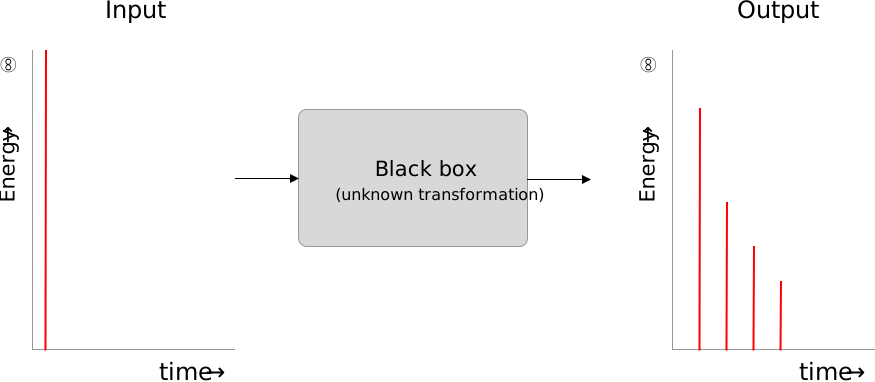
In signal processing, a black box is a system that performs some kind of transformation between an input and an output. In order to understand what it does, we measure the system’s impulse response: we feed it a short, powerful burst of energy on the input and measure its response on the output. And as our professor Stan Tempelaars said in college: “once you know a system’s impulse response, you know everything about it.”
Not long after learning about the black box concept, I brought my cello to the luthier for its annual inspection. When he began knocking on it, I realized he was black-box testing: using impulses to measure its acoustic behavior. It worked. At the bottom left, the knock sounded dull; on closer inspection, he found a hairline fracture in the soundboard.
It reminded me of Marshall Rosenberg’s Collaborative Communication. One could think of his method as psychological black-box testing: a situation knocks, a feeling responds. By paying attention to that response, we learn something about ourselves.
In the Collaborative Communication article I wrote earlier, a project manager’s incessant talking triggers a feeling of annoyance. Our reflex is to blame the trigger: the project manager is a bozo. He is annoying. But if you think about it, that’s pointless: I might as well blame the luthier for the hairline fracture in my cello. The real issue lies in us, not in who exposes it. We need to examine the feeling, our response to the trigger: we are annoyed.
So, what can we learn from a feeling? In this example, why are we annoyed? Throw out some explanations and test them: do they ring true? You might find yourself thinking: “I’m annoyed because my PM is wasting my time. I need to do my job properly. I need uninterrupted time to get things done.” Now you know something you can act on. You are no longer a victim, you are in control. You can tell the project manager about your needs. Human needs tend to be universal, which makes them easy to understand and identify with. Also in this situation with the project manager: surely he likes to do his job properly and work without interruption? Chances are that he’ll be happy to stop chatting, leave you to your work, and even feel good about himself for accommodating you.
So, just like in signal processing, measure your “impulse response”! If someone gets under your skin, they are merely “knocking” on you. Who’s knocking or why just doesn’t matter. As Marshall Rosenberg reminds us, the key to turning things around is in understanding your feelings. They reveal what’s alive in you, what matters to you. They help you work with people who you don’t necessarily like, and guide you to make your life a little easier every day.